
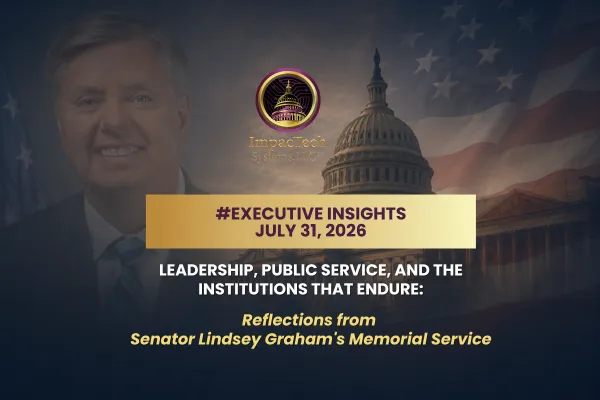
Executive Insights: Leadership, Public Service, and the Institutions That Endure
Reflections from Senator Lindsey Graham's Memorial Service
From Chief Executive Officer and Chief Innovation Officer, Krystel Reid Heath, MSW
This week, I attended Senator Lindsey Graham's memorial service to honor a life of public service and reflect on a legacy that shaped South Carolina and our nation.
Throughout the service, I found myself reflecting not only on Senator Graham's service, but also on the enduring principles of leadership, stewardship, and the institutions that connect us across generations.
Speaker after speaker returned to the same themes: service, responsibility, humility, relationships, bipartisan cooperation, and the weight of leadership. While the speakers represented different backgrounds, political perspectives, and personal relationships with Senator Graham, their collective message transcended politics. They spoke to something every executive leader eventually faces: the responsibility of stewarding institutions that will outlast any individual.
That message is worth reflecting upon.
Public Service Beyond Politics
One of the most meaningful aspects of the service was its bipartisan spirit.
Congressman James Clyburn read the Twenty-Third Psalm. Governor Henry McMaster shared stories illustrating Senator Graham's willingness to work across the aisle, including a moment when he publicly lifted Senator Fritz Hollings' hand so both leaders would receive the applause of the audience. The message was clear. Political disagreement did not eliminate the possibility of mutual respect or shared purpose.
In today's environment, where disagreement is often mistaken for division, the service offered a different perspective. It demonstrated that individuals can hold differing views while continuing to respect one another, work together, and remain committed to serving something greater than themselves.
That lesson extends well beyond public office.
Leadership Is a Responsibility
Another theme emerged throughout the service.
Leadership carries weight.
Former aide and pastor Scott Farmer reflected on the gravity of the decisions elected officials make, often involving matters of national security, public safety, and the lives of others. Those responsibilities require leaders to work together, even amid disagreement, because the consequences extend far beyond any one individual or political party.
That observation extends well beyond government.
Executive leaders, board members, nonprofit executives, legislators, agency directors, and elected officials all occupy positions that require difficult decisions. Those decisions frequently involve competing priorities, imperfect information, limited resources, and uncertainty. They are rarely as simple as they appear from the outside.
Leadership is often measured not by the absence of criticism, but by the willingness to accept responsibility when decisions are difficult.
Institutions Endure Beyond Individuals
I arrived more than two hours before the service, anticipating security, parking, and limited seating. Like many others waiting to enter the church, I spent that time talking with people I had never met.
Some worked in government.
Others represented nonprofit organizations, higher education, and community institutions.
Some had known Senator Graham personally.
Others, like me, had simply come to pay their respects.
What struck me most was not the diversity of backgrounds or perspectives represented in those conversations. It was how naturally people engaged one another. We reflected on Senator Graham's legacy, the importance of public service, and the responsibility leaders have to serve something greater than themselves. Every conversation was thoughtful. Every interaction was respectful.
That experience reminded me that civic institutions are strengthened not only by elected officials, but also by citizens who remain willing to listen, engage respectfully, and seek common ground.
As I looked around First Baptist Church, that same principle became even more apparent.
Current and former elected officials.
Members of Congress.
Faith leaders.
Military leaders.
Judges.
Public servants.
Community leaders.
Citizens.
They represented different professions, different political perspectives, and different life experiences. Yet they had gathered for a common purpose: to honor a life of public service and to recognize the enduring importance of the institutions Senator Graham served.
Perhaps that is one of the most important lessons from the day.
No leader serves forever.
Institutions endure.
Senator Graham's passing immediately initiated constitutional and statutory processes that ensure continuity of representation. An interim appointment was made. A special election is underway. The Senate continues its work. Government continues to function.
Strong institutions are designed to endure leadership transitions.
The same principle applies to executive leadership.
Healthy organizations develop governance structures, succession planning, strategic capacity, and resilient leadership that extend beyond any one executive. Individual leaders matter. Institutions matter even more because they carry the mission forward across generations.
Character Is Often Remembered More Than Accomplishment
The service also reminded me that people often remember leaders differently than history books do.
Speakers certainly reflected upon Senator Graham's legislative accomplishments, committee leadership, judicial priorities, and policy work. They also remembered his humor, generosity, friendships, willingness to mentor others, and his commitment to serving causes larger than himself. Former Congressman Trey Gowdy shared stories that revealed not only Senator Graham's public leadership but also his personal character and enduring friendships. Senator Tim Scott offered moments of levity while reflecting on Senator Graham's deeply held convictions and his encouragement to remain authentic and stand up for those who cannot stand for themselves.
Titles eventually pass.
Positions change.
Relationships, character, and the manner in which leaders serve others often become their most enduring legacy.
Executive Implications
As I reflected on the service, three leadership lessons stood out that extend well beyond government.
Leadership requires a long-term perspective.
Political transitions often dominate headlines for a few days. Effective executive leaders focus on what follows. Leadership changes influence governance, strategic priorities, funding, organizational culture, and long-term direction. Preparing for those transitions before they occur enables organizations to respond with confidence instead of reacting under pressure.
Strong institutions prepare for continuity.
One of the most reassuring aspects of our democratic system is that institutions continue to function even as leaders change. The same principle applies within organizations. Boards, executive teams, governance systems, and succession planning should be designed to sustain the mission regardless of who occupies a particular leadership role.
Respect remains a leadership strength.
Perhaps the most lasting impression from the day was not political agreement. It was the willingness of people from different backgrounds, professions, and perspectives to engage one another with dignity and respect. In an era often defined by polarization, respectful dialogue remains one of leadership's most valuable competencies. Organizations are stronger when leaders build trust, encourage thoughtful discussion, and remain committed to a shared purpose even when perspectives differ.
Executive Advisory
Throughout my career, I have learned that the greatest value I can provide executive leaders is not simply interpreting legislation, regulations, or political developments. It is helping leaders understand what those developments mean for executive decision-making before they become operational challenges.
The memorial service reinforced that leadership is ultimately an exercise in stewardship. Executive leaders are entrusted with organizations, missions, and institutions that should endure beyond their individual tenure. That responsibility requires more than responding to today's challenges. It requires preparing organizations to navigate tomorrow's uncertainty.
The Strata Executive Response System™ was developed to strengthen that executive capacity. Through structured executive intelligence, legislative analysis, strategic response frameworks, and decision-support resources, Strata equips executive leaders of mission-driven organizations to anticipate legislative, governance, funding, and operational disruption before it becomes organizational crisis.
The most enduring institutions are built by leaders who understand that their responsibility extends beyond the decisions they make today.
It extends to the organizations, people, and communities they prepare for tomorrow.