
Executive Insights The Evolution of Strata and What I Share
From Chief Executive Officer and Chief Innovation Officer, Krystel Reid Heath, MSW
The Evolution of Strata™ and What I Share
It has been a while since I published here on Executive Insights. That pause was intentional.
As I developed The Strata Executive Response System™, I became more deliberate about how my public writing would fit alongside the proprietary intelligence and executive application resources I was building.
The work prompted two connected questions: How could I deliver meaningful, actionable intelligence to organizational leaders? And what should I continue sharing publicly as that system took shape?
Preparing Strata’s™ first founder briefing brought both questions into sharper focus.
What the build revealed
I designed Strata™ after more than two decades of policy work. My purpose was to help organizational leaders anticipate, interpret, and respond to policy and funding disruption.
Bringing that purpose into practice required months of development. In the days leading up to the founder briefing, I spent considerable time researching developments, assessing their significance, and deciding what belonged in a 45-minute executive discussion.
The research covered South Carolina’s policy and funding landscape: the state budget, key legislative developments, agency and system changes, and their implications for community-serving organizations. It also covered the federal landscape, including funding conditions, key legislative developments, and anticipated congressional activity.
The work then moved into interpretation and application. I developed executive implications, reflection questions, and resources intended to help leaders connect those developments to their organizational responsibilities.
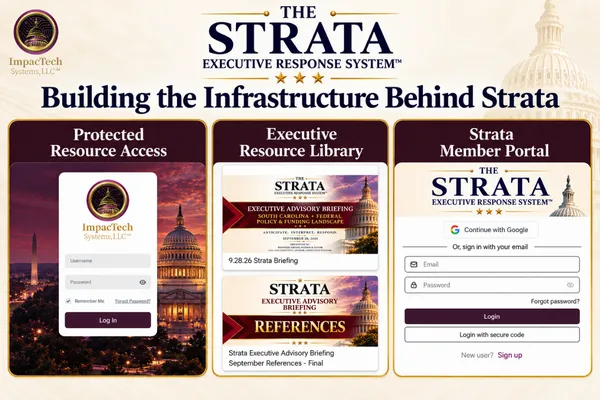
Alongside that work, my development team built the Strata Executive Resource Library™ and integrated it into the Strata™ portal. This added another layer of protection for the executive application resources and enhanced how leaders access them.
As the briefing came together, I could see more clearly how much meaningful application depended on industry specificity.
A child welfare executive and an affordable housing executive may follow the same legislative development. Its implications for their funding, operations, and decisions can differ substantially. Faith-based organizations bring distinct operating realities.
A broad briefing could help leaders understand the landscape. Connecting that intelligence to the decisions they faced required a more focused approach.
The realization that changed the model
The founder cohort experience helped me recognize that the delivery model needed to evolve alongside the resources.
I had invested significant thought, time, and care into the original model. Putting it into practice gave me information I could use to reconsider its direction.
I began looking more closely at the institutions already responsible for strengthening organizations across these industries: foundations, associations, and membership organizations.
That was the pivot.
Strata’s™ natural evolution was to serve these institutions exclusively, enabling them to provide industry-focused executive intelligence and application resources to their grantees or members.
This model creates a path to reach more organizations through institutions already invested in their effectiveness. It also provides a clearer basis for organizing the intelligence around the industries those institutions serve.
Conversations with funders and grantmaking institutions reinforced the need. Policy and regulatory environments affect how funded organizations carry out their programs. Changes can create additional operating challenges while leaders are working through uncertainty about funding, implementation, and future requirements.
Those conversations strengthened my understanding of how executive preparedness connects to organizational capacity, and why institutions supporting multiple organizations have a meaningful role in providing access to it.
My initial focus remains child welfare, affordable housing, and faith-based organizations.
Building the capacity to deliver
The institutional model also requires a dependable support structure.
I am now building the team and capacity around policy research, technical support, onboarding, account management, and technical enhancements that make Strata’s resources more useful and actionable.
This work involves defining responsibilities, evaluating support partners, and determining how capacity should grow as institutions participate.
The Executive Resource Library is one completed part of that infrastructure. The next stage is developing the people, processes, and support needed to deliver the experience consistently across organizational networks.
I am still in the middle of that work. The direction is clearer because of what the development process revealed.
How Executive Insights is evolving
Building Strata™ has also clarified the role of this blog.
Executive Insights will remain a place for my perspective on leadership, organizational preparedness, and the relationship between policy environments and executive responsibility. It will also provide space to reflect on the decisions and lessons that emerge from building systems to support that work.
Strata™ houses the structured executive intelligence, proprietary resources, and focused application support developed for participating institutions and their networks.
That distinction allows me to be intentional about what I publish here. Public writing can illuminate an issue, offer perspective, and share lessons from experience. The research, interpretation, and application resources developed for Strata belong within its protected environment.
This article reflects that direction. It shares what the process taught me and how I responded to it.
Carrying the lessons forward
One of the most meaningful lessons from this experience has been the importance of giving myself room to learn from something I worked hard to create.
Experience helped me establish the purpose. Preparation gave me a starting point. Putting the model into practice helped me see a stronger path.
That required examining the work honestly and trusting my judgment when the next step differed from the one I had imagined.
Strata™ is evolving, and so is what I share here. Both are guided by the same commitment: helping leaders make informed decisions amid policy and funding uncertainty.
I’m grateful for the clarity this process has brought, and I’m carrying those lessons forward as I continue to build.
Learn more about The Strata Executive Response System™ at strata.impactechsystems.com.